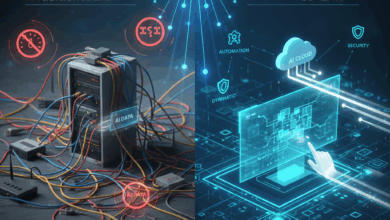
For years, phishing has been the most common form of cyberattack, flooding inboxes with suspicious links and poorly written emails that were often easy to spot.
Security teams became adept at filtering them out, and employees learned to be wary of messages that looked even slightly unusual. Recently, however, something remarkable has happened.
Phishing is Falling
The overall volume of phishing attempts has declined, with global numbers dropping by around twenty percent and the United States seeing an even sharper fall of thirty-two percent.
At first glance, this might seem like progress, a sign that organizations are finally winning the battle against cybercriminals. But the reality is far more complex, and far more troubling.
The decline in volume does not mean the threat has diminished. Instead, attackers are shifting their focus, using artificial intelligence to create fewer but far more dangerous campaigns.
The New AI Wave
The new wave of attacks is not about sending millions of generic emails in the hope that a few people will click. It is about precision.
Cybercriminals are now targeting specific departments that hold the keys to sensitive information and financial resources. IT teams, human resources, payroll, and finance are all in the crosshairs.
These are the areas where a single successful breach can yield enormous rewards, whether that means access to critical systems, employee data, or direct financial transactions.
By narrowing their focus, attackers increase their chances of success, and by using AI, they make their attempts far harder to detect.
Generative AI has become the weapon of choice for these criminals. With it, they can craft emails that look indistinguishable from legitimate communication.
Gone are the days of broken English and suspicious formatting. Today’s phishing emails are polished, professional, and often personalised. They may reference real projects, mimic the tone of actual colleagues, or even include logos and branding that appear authentic.
AI can also generate deepfake content, producing audio, video, or images that impersonate trusted sources. Imagine receiving a voicemail that sounds exactly like your manager, instructing you to approve a payment, or a video call where the person on the screen looks and speaks like a senior executive but is in fact a synthetic creation.
These scenarios are no longer science fiction. They are happening now, and they are redefining what it means to trust digital communication.
These Guys are Artists!
The creativity of attackers does not stop at emails and deepfakes. A particularly alarming trend is the use of fake AI assistants and chatbot interfaces.
These malicious tools are designed to exploit the growing trust people place in conversational platforms. On services such as Telegram, Steam, and Facebook, criminals are deploying chatbots that appear helpful and legitimate. Victims may believe they are interacting with a customer support agent or a productivity assistant, when in reality they are being manipulated into handing over credentials, downloading malware, or entering payment information.
The interface feels familiar, the responses seem natural, and the deception is seamless. By weaponizing the very technologies that businesses and individuals are adopting for efficiency, attackers are turning trust into vulnerability.
Time to Evolve
This shift in tactics highlights a sobering truth: the old defenses are no longer enough. Traditional perimeter-based models, which rely on keeping threats outside a defined boundary, are ill-suited to a world where attacks are personalized, adaptive, and often indistinguishable from legitimate activity.
Organisations must rethink their approach to security.
The concept of Zero Trust is becoming more than a buzzword; it is a necessity.
Zero Trust frameworks operate on the principle that no user, device, or application should be trusted by default. Every interaction must be verified continuously, and access should be granted only when strict conditions are met. This approach reduces the chances of an attacker slipping through unnoticed, even if they manage to compromise one part of the system.
Using AI Defensively
AI itself must also be part of the defense. Just as criminals are using generative models to create convincing attacks, security teams can deploy AI to detect anomalies, identify synthetic content, and flag suspicious behavior.
The battle is increasingly one of machine against machine, with success depending on which side can innovate faster. For businesses, this means investing not only in technology but also in training.
Employees must be educated about the new forms of deception, taught to question even the most convincing messages, and encouraged to verify requests through multiple channels before taking action.
Persona Based AI Attacks
The implications of these developments are profound. A payroll clerk who receives a realistic email from what appears to be the HR department may unknowingly expose employee data.
A finance officer who hears what sounds like their manager’s voice authorizing a transfer may move funds directly into a criminal’s account.
An IT administrator who interacts with a fake chatbot may hand over credentials that unlock critical systems.
Each of these scenarios represents not just a potential breach but a direct threat to the functioning of the organization.
The damage can extend beyond financial loss to reputational harm, regulatory penalties, and erosion of trust among employees and customers.
Wave Two Preperation
It is tempting to view the decline in phishing volume as a victory, but in truth it is a warning. The attackers are not retreating; they are evolving. They are trading quantity for quality, and they are using tools that make their efforts more convincing than ever before.
Businesses that fail to adapt risk being caught off guard by attacks that bypass traditional filters and exploit human trust. The challenge is no longer simply to block suspicious emails but to recognize that deception can take many forms, from deepfake videos to malicious chatbots.
The rise of AI-driven cyberattacks marks a turning point in the digital security landscape. It demands a new mindset, one that accepts that threats are dynamic and that defenses must be equally adaptive.
Organisations must embrace Zero Trust, leverage AI for detection, and foster a culture of vigilance among employees. The stakes are high, and the margin for error is shrinking.
Phishing may be declining in volume, but its effectiveness is climbing rapidly. The future of cybersecurity will be defined not by how many attacks are stopped, but by how well we can anticipate and counter the evolving strategies of adversaries who are as innovative as they are relentless.